Complete Guide to
Hair Transplants Abroad
What you need to know before traveling abroad for a hair transplant.


In this article
- What is a hair transplant?
- What are the different types of hair transplant?
- What happens before, during and after a hair transplant?
- How do you plan your new hairline?
- What are the risks of a hair transplant?
- Why do people get hair transplants abroad?
- How do I choose a hair transplant surgeon abroad?
- How much does a hair transplant cost abroad?
- Frequently asked questions
A hair transplant with Essos starts at $3,000 in Turkey, compared with $5,000-$15,000 in the US, as of October 2026.
Essos is a US concierge whose medical board vets surgeons and clinics, so you can compare them and choose.
These checks work on any clinic, whether or not you book through Essos.
What is a hair transplant?
A hair transplant is surgery that moves hair follicles from a donor area of your scalp, typically the back or sides, to thinning or bald areas. How much hair you've lost and how full you want the result to be determine how many grafts you need.
A good plan shapes your hairline and manages your donor supply so your new hair blends with your existing hair and looks natural as you age.[1]
What is a hair graft?
A hair graft is a tiny, natural cluster of one to four hairs, taken from your donor area and transplanted as a single piece.[6] Essos' Hair Transplant Cost Comparison Guide compares prices by country.
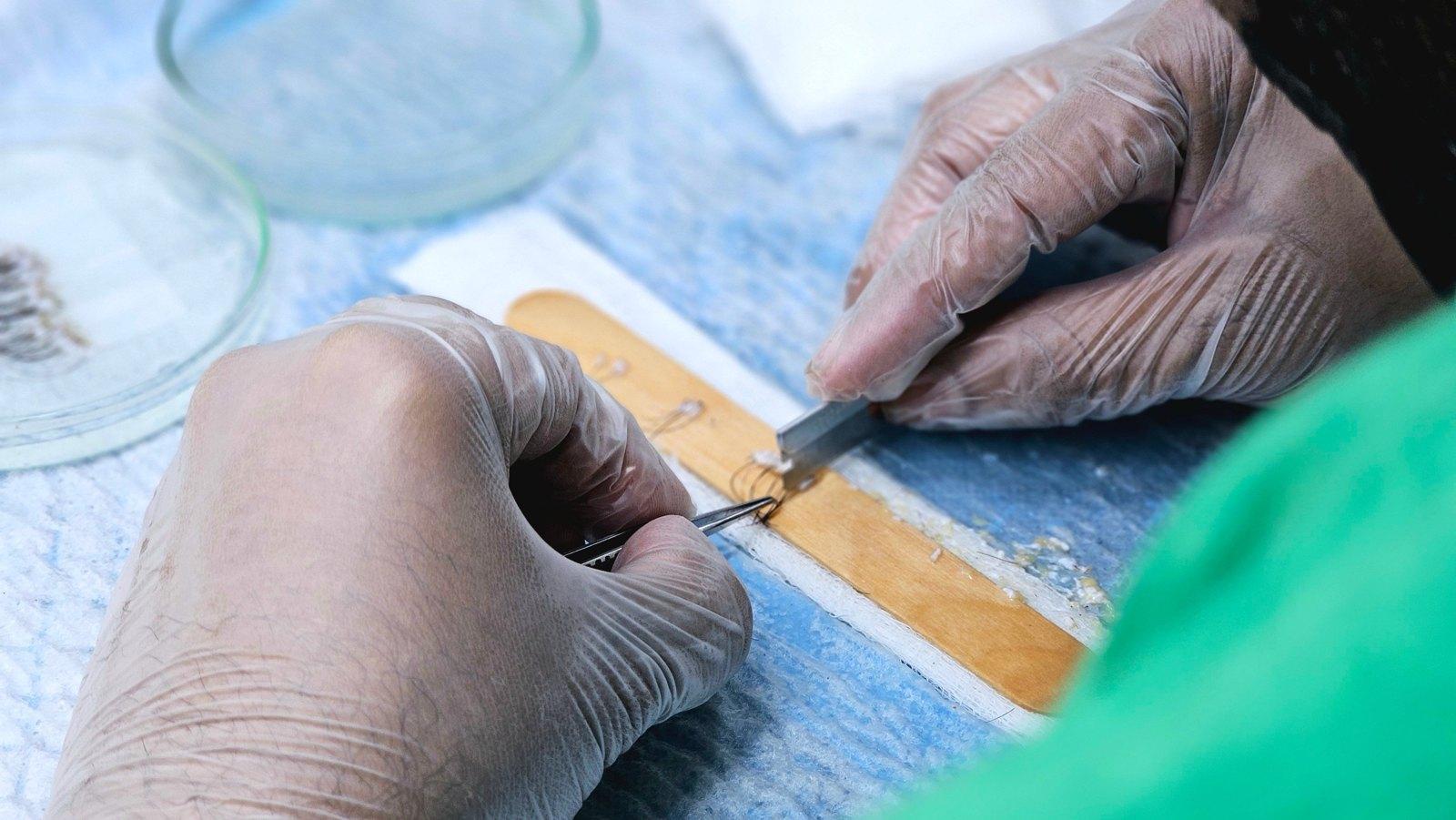
Donor hair being trimmed into individual grafts
Which types of hair loss can a hair transplant treat?
There are four main types of hair loss, and a transplant helps with some more than others.
| Name | Can a transplant help? |
|---|---|
| Male pattern hair loss | Often, with enough healthy donor hair[2] |
| Female pattern hair loss | Sometimes; see hair transplants for women[3] |
| All-over thinning (diffuse unpatterned alopecia) | Generally no, because it reaches the back and sides, leaving no safe donor area[4] |
| Patchy hair loss (alopecia areata) | Not while active, because surgery can trigger a flare[4] |
Norwood scale: the stages doctors use to assess male hair loss
Doctors use a standard 7-stage system called the Norwood scale to grade how far your hairline has receded and your crown has thinned:[1][9]
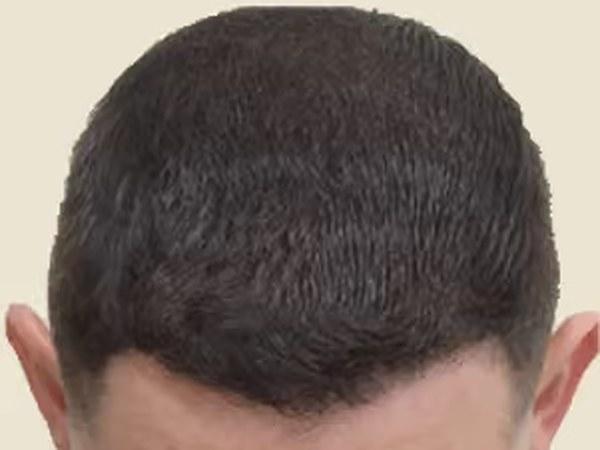
Stage 1
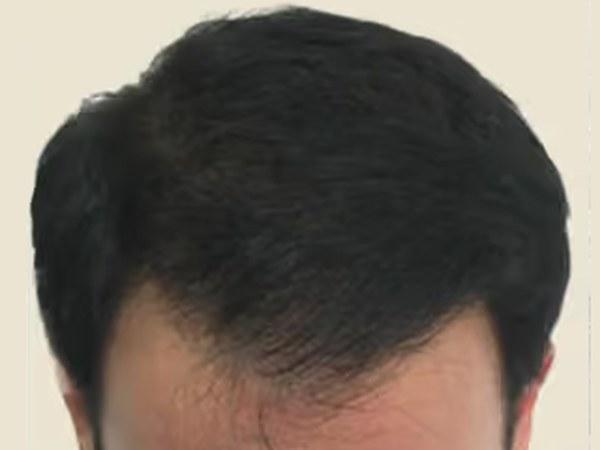
Stage 2
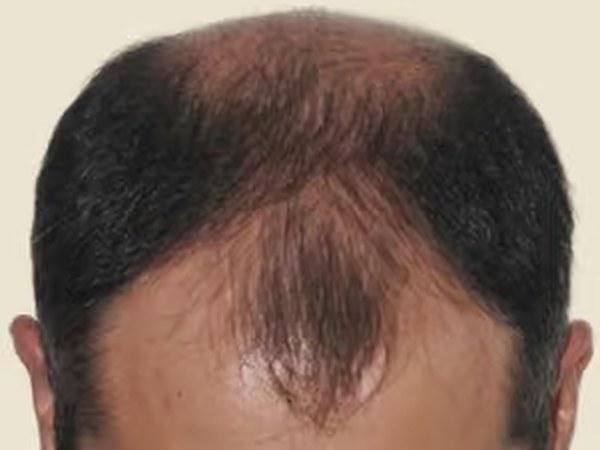
Stage 3
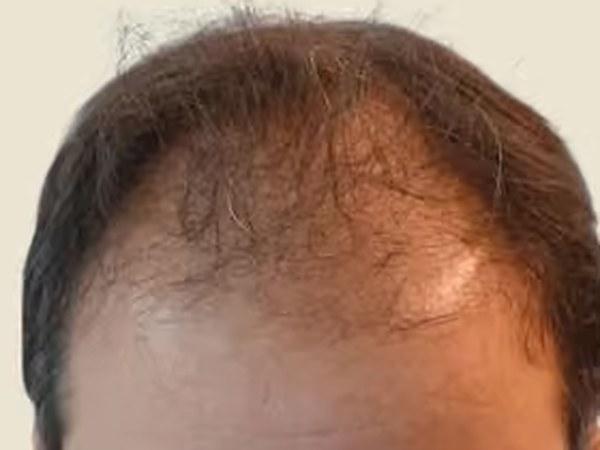
Stage 4
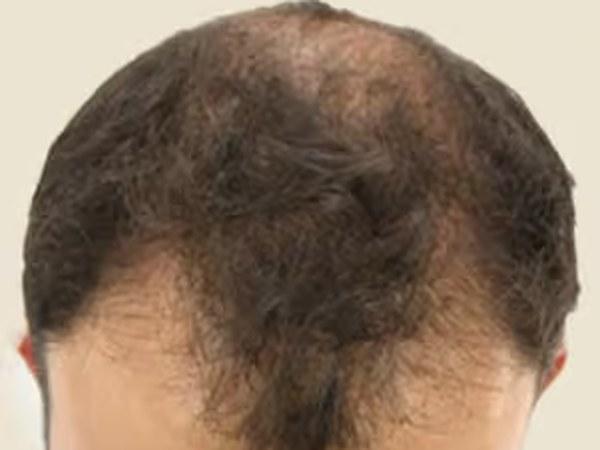
Stage 5
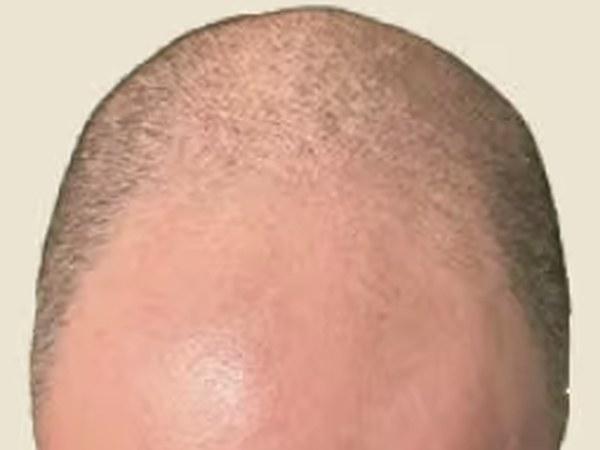
Stage 6
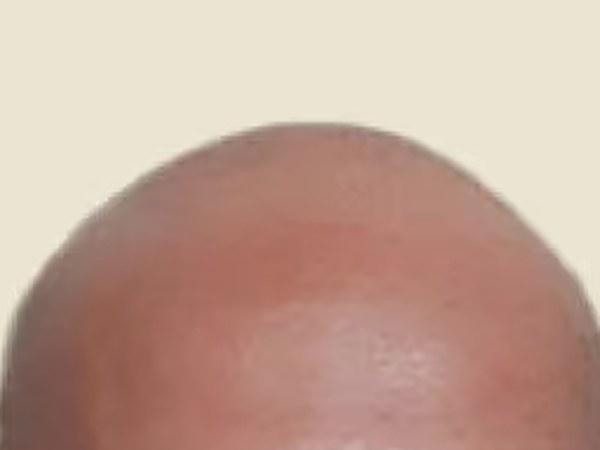
Stage 7
Norwood scale, stages 1-7, in real photos.
- Stages 1-2: little loss, or slight recession at the temples. It's usually too early for surgery, so doctors start with medication.[1]
- Stages 3-5: the temples recede further and the front starts to meet a thinning crown. This is usually a good time for a transplant.[1]
- Stages 6-7: the front and crown have joined, leaving hair mostly at the back and sides. A transplant is still possible, but limited donor hair may mean more than one session.[1][4]
Women's thinning is graded on a different scale; see hair transplants for women.
Who is a good candidate for a hair transplant?
You might be a good candidate if you have:[2,3,4]
- Enough healthy donor hair
- Healthy scalp in the transplant area
- Hair loss that has become stable or predictable
If you're in your 20s, your hair loss may not have settled yet, so many surgeons suggest starting with medication and keeping the first plan conservative.[4]
What can a hair transplant do, and what can't it?
A hair transplant can give you a fuller head of hair, typically by moving hair to a receding hairline, the temples or a thinning crown. It can't stop pattern hair loss, though, so your doctor may also recommend medication such as minoxidil and, for men, finasteride (see aftercare below).[2][18]
Be wary of any surgeon who promises a full head of hair before looking closely at your scalp, because how much donor hair you have decides how much a transplant can cover.
What are the different types of hair transplant?
The two main types of hair transplant are FUE and FUT, which differ in how the surgeon takes hair from the donor area.[5] You may also hear the terms DHI and sapphire FUE, and a few things differ for women.
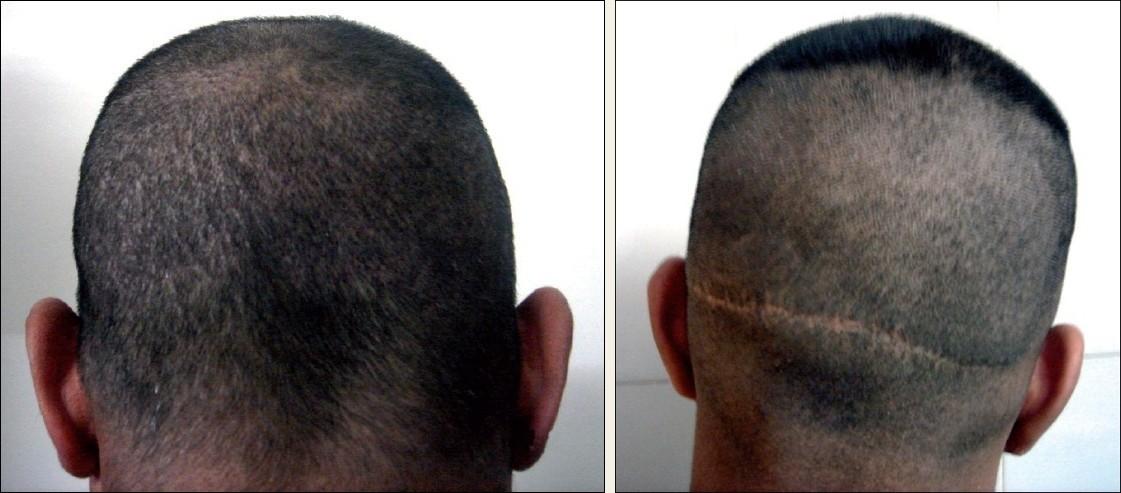
FUE (left): scattered dots. FUT (right): one thin line scar. Photos: Dua and Dua, J Cutan Aesthet Surg 2010, CC BY.
FUE vs FUT hair transplant
FUE
FUE (follicular unit excision) takes out grafts one at a time with a tiny round punch, leaving small dot scars that are difficult to notice, even with short hair.[6] It's now the most common method, used about 85% of the time for men, and because it's slower and more technically demanding, it typically costs more per graft at US clinics that offer both.[7,8]
FUT (strip)
FUT (follicular unit transplantation), also called strip surgery, is the traditional method, where the surgeon removes a thin strip of scalp from the back of the head and the team separates it into individual grafts under a microscope.[5,9] FUT usually costs less because it skips thousands of single extractions, but it leaves a long, thin scar that shows with fades, buzz cuts and other very short styles.[6,8,9]
DHI hair transplant (direct hair implantation)
DHI is FUE with a different last step.
In standard FUE, the openings where grafts go (recipient sites) are usually cut first and the grafts placed afterward. With DHI, a sharp implanter, a hollow needle loaded with one graft, cuts each opening and pushes the graft in with a single press.[5]
Implanters can help place grafts between long hairs, so you may not need to shave the transplanted areas, which clinics often call unshaven FUE.[10] Because the implanter cuts the skin as it places each graft, a licensed doctor must be the one using it.[5][36]
Sapphire hair transplant (sapphire FUE)
Sapphire FUE is done with sapphire blades.
Sapphire hair transplant is a marketing name for FUE done with sapphire blades, which cut the openings that receive the grafts.[5,11]
Surgeons who use them say the sharper, smoother blades cut smaller, cleaner openings that heal faster, though the evidence is still mixed.[11][12] In one study, about 95 in 100 grafts survived with sapphire blades against 89 in 100 with steel, while another found ordinary razor blades did less damage to the scalp's blood vessels.[11,12]
Hair transplants for women
A hair transplant can work for some women with female pattern hair loss, and all of this guide applies to women as well, with a few differences:[3]
- If your thinning stays along your part and crown while the back and sides stay thick, a transplant may work for you. If it has spread there too, a specialist should take a closer look, such as a scalp exam, before surgery is an option
- Hormone changes from pregnancy, menopause, thyroid problems or PCOS can also cause thinning, so a specialist should rule them out first, often with blood tests
- Many women choose FUT over FUE, because it doesn't require shaving and long hair hides the strip scar
- Women usually want the part and crown filled in more than they want a new hairline, so the plan focuses on those thinner areas
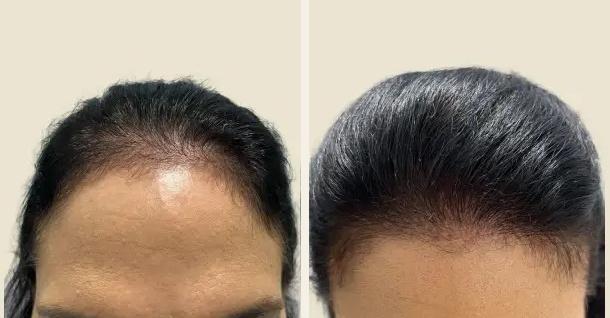
Before and after: a woman's front hairline filled in.
Results vary with anatomy, skin, and healing.
What happens before, during and after a hair transplant?
A hair transplant starts with a consultation and a few weeks of preparation, then an operation of 4-8 hours, usually while you're awake.[1][2] You may need 1-2 weeks off work, and the full result usually shows at 10-18 months.[13]
What happens at the consultation?
The surgeon checks the density of the hair at the back and sides, then gives you their view on your hairline.[14] Expect questions about your general health too, and possibly a blood test to confirm why you're losing hair.[2]
Your surgeon also plans your new hairline with you and draws it on your forehead with a marker, so you can visualize it before any grafts go in[21] (more on planning your hairline below).
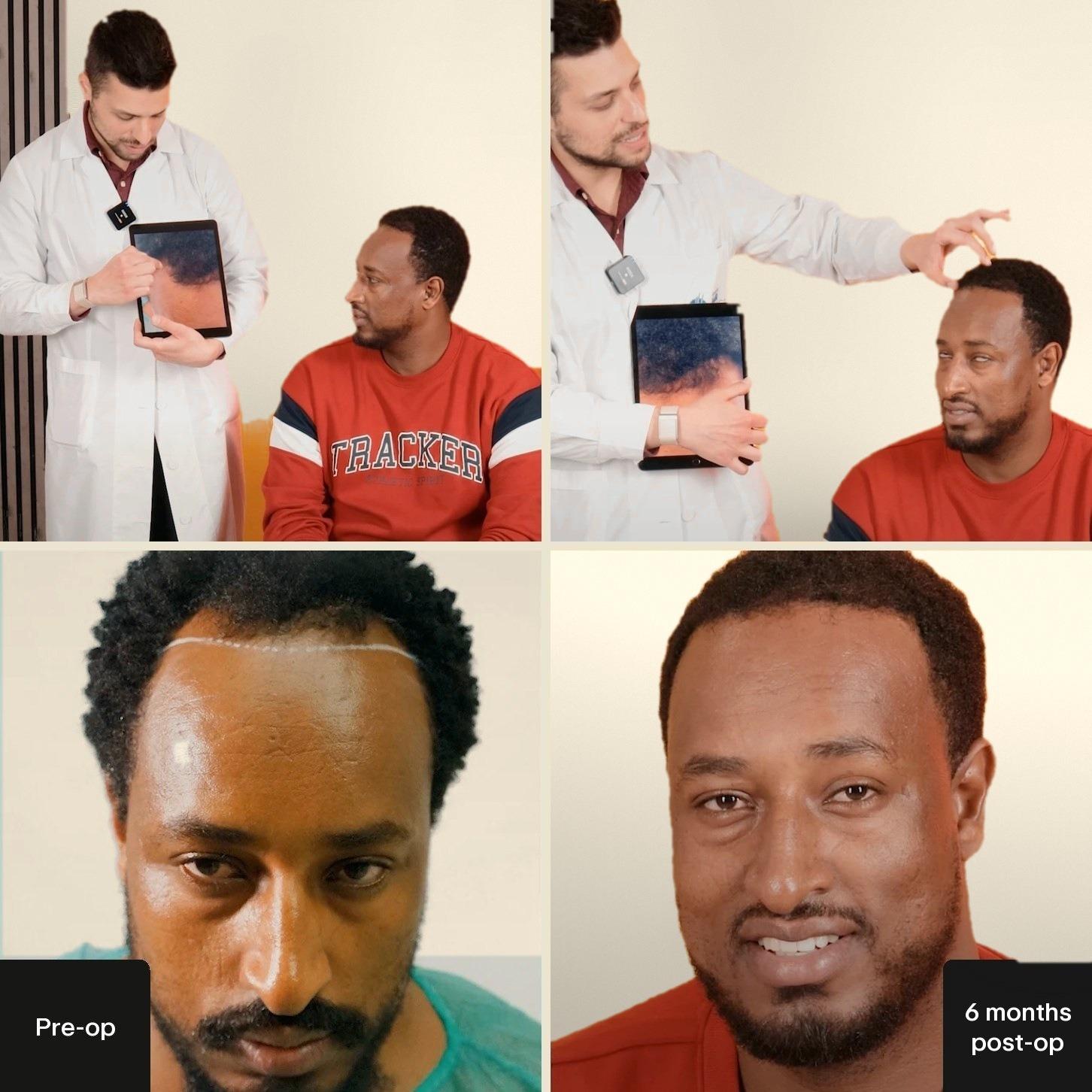
Top: a surgeon in the Essos network checks a patient's new hairline at a follow-up visit. Bottom: before surgery, with the planned hairline drawn on, and 6 months after. Results vary with anatomy, skin, and healing.
Before you leave, ask for a written plan that covers:[14]
- Your hairline design (see how surgeons plan a hairline)
- Planned number of transplanted grafts
- The result to expect, and when
- Any medication or second surgery you may need later
How do you prepare for a hair transplant?
Before surgery, your surgeon will usually ask you to stop:
- Smoking: 3-6 weeks before[1]
- Anti-inflammatory painkillers: such as ibuprofen (NSAIDs), about 1 week before[1]
- Minoxidil: about 1 week before[14]
- Alcohol: about 1 week before[14]
- Supplements: vitamins and herbal products (tell your surgeon about every one you take)[1]
For travel-specific steps, see how to prepare for surgery abroad.
What happens on surgery day?
A hair transplant usually takes 4-8 hours, and you should expect to be awake, with your scalp numbed by local anesthesia. You shouldn't need to stay overnight, though a large area may need 2 or more sessions on different days.[13]
If you're traveling alone, ask who takes you back to your hotel and who you can call that night.
Hair transplant recovery week by week
Your grafts need the most care in the first 2 weeks while scabs clear and any swelling goes down.[13]
Recovery timeline
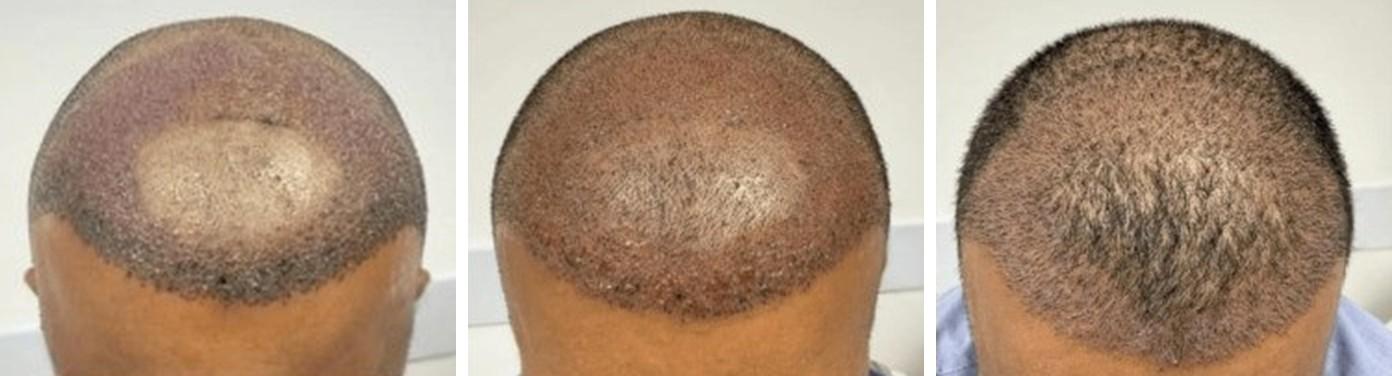
One patient on days 1, 3 and 5 after surgery (left to right). He also had oxygen therapy and healed faster than usual; scabs usually clear by days 7-10. Photos: Giardiello et al., Cureus 2025, CC BY 4.0 (cropped).
When should you call your surgeon?
Call your surgeon right away if redness, pain, swelling or bleeding gets worse, or if you have a fever of 100.5°F (38°C) or higher, pus or honey-colored crusts around the grafts, or scabs still there after 2 weeks.[13,15,16]
What does hair transplant aftercare look like?
Before you travel, agree on a plan for any problems with both your own doctor and your surgeon, and ask the clinic for copies of your medical records in English.[17] A hair transplant moves hair but doesn't stop pattern hair loss, so your doctor may recommend medication such as minoxidil and finasteride.[2][18][35]
Minoxidil is an over-the-counter liquid or foam that you apply to your scalp twice a day.[18] It is mainly used to slow hair loss, but it can often strengthen and regrow hair.[18]
Finasteride is a daily prescription pill that slows, and sometimes reverses, male pattern hair loss.[18,19] It can cause side effects, including erectile dysfunction in about 1% of men, so decide with your doctor before you start.[19]
Finasteride takes about 6 months to show a visible difference and minoxidil can take 6-12 months, so ask your surgeon when to start or restart them after surgery.[18]
How do you plan your new hairline?
You and your surgeon plan your hairline together, balancing what your donor hair can do with the result you want. A good plan saves donor hair for the years ahead and gives you a hairline that looks natural.
Planning for the long term
Your donor hair is limited, and pattern hair loss can keep going after surgery, so a good plan reserves grafts for the future.[20] That's why a surgeon may suggest a slightly higher, more conservative hairline, which still looks natural as you age and leaves grafts for the crown or a second session if you need one.[1,4] A low, flat hairline, for instance, can end up looking out of place in young men, as their own hair keeps thinning behind it.[4]
What makes a hairline look unnatural?
How natural a hair transplant looks depends mostly on the surgeon's hairline design, the angle of each graft and how evenly the grafts are spread.[6] A hairline can look unnatural when grafts sit in clumps, which doctors call a "pluggy" or "doll's-hair" look, when the line is too straight or too dense, or when it sits too low or too high for your face. For example, a perfectly straight row of grafts across the forehead tends to look drawn on and obvious.[14]

Natural: soft and slightly uneven
Results vary with anatomy, skin, and healing.
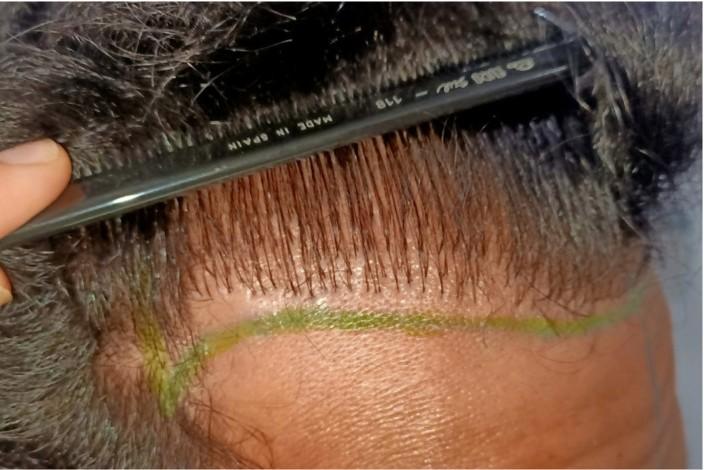
Unnatural: a dense, straight row of grafts. Photo: PMC12909172, CC BY.
Planning the right hairline
A transplanted hairline looks natural when it copies a normal one, which is soft and slightly uneven, with single hairs at the very front and fuller grafts behind them.[3][14] Many surgeons draw the proposed line on your scalp with a marker, so you can see it before anything is done.[21]
What are the risks of a hair transplant?
Serious complications after a hair transplant are uncommon. Large studies from when strip surgery (FUT) was the main method put the overall complication rate at about 1 to 5 in 100 people.[15] The figures further down come from newer FUE studies and count mild, usually temporary problems too, so they run higher.
Infection is rare after an FUE hair transplant, usually fewer than 1 in 100 people.[15] Flying home adds some risk of its own, covered below.
What side effects are normal after a hair transplant?
Swelling, scabs and itching are common after a hair transplant and usually fade with time. Forehead swelling is the most common, in nearly half of all cases with FUE.[15] The recovery timeline above shows when each eases.
What complications can a hair transplant cause?
Complications can include:[15]
- Shedding of your own hair near the grafts (shock loss), usually temporary, in up to 15 in 100 people and more often in women
- Pimple-like bumps around the new hairs (folliculitis), in about 12 in 100 people
- Numbness that lingers, usually clearing within 4-8 months
- Thinning at the back or sides of your head if too many grafts are taken (overharvesting), which can be permanent
- Grafts that grow less than expected, most often because they were damaged during surgery
Before you book, ask how many grafts your surgeon can safely take and how likely shock loss is for you.
What is the hair transplant success rate?
Hair transplants have a high success rate, with about 85-93% of transplanted grafts surviving and 90-97% of patients satisfied with their results.[22]
Does flying home add to the risk?
Traveling after any surgery adds to the risk of blood clots. There's little research on blood clots after hair transplants, but long operations and long flights both raise the risk.[23][26] After cosmetic face surgery, a clot follows about 1 in 10,000 operations within a month.[24]
On a long flight, take an aisle seat, walk when you can and drink plenty of water. Ask your surgeon when you're fit to fly and whether compression stockings suit you.[25]
What lowers your risk?
You can lower your risk by:[1,15,25]
- checking your surgeon's credentials and asking who does each step
- stopping smoking 3-6 weeks before surgery
- telling your surgeon about health conditions such as diabetes, and any medication you take
- following your aftercare instructions
- leaving time for a check with your surgeon before you fly
Why do people get hair transplants abroad?
Most people get a hair transplant abroad for the lower cost, but there are trade-offs to weigh:[26][28]
| At home (US) | Abroad | |
|---|---|---|
| Price | Usually higher | Often a third or less; see the cost section below |
| Time away | Usually home the same day | Plan about 10-17 days[25] |
| Follow-up | In person with your surgeon | Video or phone, plus a doctor near home[25] |
| Another session | Done nearby | May mean traveling back |
| Checking your surgeon | State licenses and board certification are easy to look up | Rules vary by country, so plan more time to check your surgeon's training and results |
Quality can match home at well-vetted clinics, but it varies more from country to country, so vetting matters more abroad.[17,27] Wherever you go, your surgeon and aftercare plan matter more than the destination. For prices by country, see the Hair Transplant Cost Comparison Guide.
Where do people travel for a hair transplant?
Istanbul, Turkey, is often called the world's hair transplant capital, and Mexico and Thailand also draw many US patients.[17][28]
From most US cities, the flight home takes about 2-6 hours from Mexico and about 10-15 hours from Turkey. Read more in our top 10 countries for medical tourism.
Planning your trip: when to arrive, fly home and follow up
Plan about 10-17 days, and while timings vary by surgery plan and surgeon, the trip roughly follows this order:[17,25]
- At least 3 days before surgery: arrive, rest after the flight and meet your surgeon in person
- 1-2 weeks after surgery: stay at your hotel to recover, with time for any FUT stitches to come out
- Before you fly home: at least one check with your surgeon to catch any early problems (Essos packages include follow-up)
- Once your surgeon clears you to fly: fly home, because flying sooner raises clot risk
- Once you're home: video or phone reviews at 1-2 weeks and 6 weeks to 6 months to track recovery
How do I choose a hair transplant surgeon abroad?
Check four things, in this order:
- Credentials: check with the official register in their country
- Results: recent, unedited before-and-afters of hair loss like yours
- Video call: with the surgeon, before you pay anything
- Price: what it includes, and who pays if you need another session
How do you check a surgeon's credentials by country?
The right credentials differ by country, so look the surgeon and clinic up in the official listings below.[29]
| Country | What to check | Where to check |
|---|---|---|
| Turkey | A Ministry permit for the clinic's hair transplant unit, and a plastic surgeon, dermatologist or Ministry-certified doctor[30] | Ministry of Health list of approved centers, or ask to see the permit |
| Mexico | A specialist license (cédula de especialista) and a current specialty council certificate, both required by law[31] | SEP license register and CONACEM specialist search (in Spanish) |
| Thailand | A Thai medical license | Medical Council doctor search (in English) |
| Anywhere | ISHRS membership or ABHRS certification[29,32] | ISHRS Find a Doctor, ABHRS directory |
What should you ask a hair transplant surgeon before booking?
- Will you do my surgery yourself?
Listen for a surgeon who draws your hairline and makes the openings where your grafts go. In some countries, including Turkey, certified nurses and technicians may take out and place grafts under a doctor's supervision, so ask who does each step.[29,33] - How many surgeries will you oversee at the same time as mine?
If it's more than one, someone else is likely doing much of yours.[29] - How many hair transplants have you done?
Listen for a specific number, like how many they did last year.[34] - Can I see before-and-afters of your own patients?
Look for this surgeon's own results, not photos from the clinic's other doctors.[29] - How many grafts do I need, and how many will you leave for later?
A good plan keeps some donor hair in reserve in case your hair keeps thinning.[20] - What does the price include, who pays if I need another session, and who looks after me once I'm home?
Get all three in writing before you pay.[14][34]
What are the red flags when booking a hair transplant abroad?
Any of these is a reason to pause and ask more before you book:[29,34]
Before you pay
- Being asked to pay before you've met the surgeon who will operate.
- Pressure to book fast, such as a time-limited deal.
- One low price for "as many grafts as possible," which can thin your donor area.
- Ads promising "unlimited grafts," "guaranteed results" or "scarless" surgery.
- A "board-certified" surgeon who won't say which board.
- A price quoted per hair, not per graft.
- Glowing reviews posted at the same time or written the same way.
At the consultation
- Unlicensed staff making any incision in your scalp, including those that take out grafts in an FUE hair transplant, or a non-doctor deciding your plan.
- One surgeon overseeing several surgeries at once.
- No direct way to reach your surgeon, only a coordinator.
- Every hairline in their before-and-afters looks the same.
How does Essos vet hair transplant clinics?
How much does a hair transplant cost abroad?
A hair transplant with Essos starts at $3,000 in Turkey, from Essos partner-clinic prices in October 2026. In the US it costs about $5,000-$15,000.[38][39]
Your trip typically includes:
- Your surgeon, anesthesia and operating room fees
- A consultation before surgery
- Local transport
- A hotel stay
- English-speaking care coordination
- Follow-up after surgery
Not usually included, so budget for:
- Flights
- Hotel nights beyond any included
- Time off work
- Medication
- Follow-up visits at home
- Extra costs if a complication happens
- Turkey~$1,700-$3,400
- Turkey with Essos$3,000-$4,000
- United States$5,000-$15,000
- United Kingdom~$1,300-$39,700
Dashed line: US average $10,153
For a detailed country-by-country cost breakdown, see the Hair Transplant Cost Comparison Guide, or read about hair transplant cost in Turkey.
Frequently asked questions
Is it safe to get a hair transplant abroad?
Is it safe to get a hair transplant in Turkey?
Is it safe to get a hair transplant in Mexico or Thailand?
Safety in Mexico or Thailand comes down to the surgeon you choose, and you can check their license before you book. In Mexico, including Tijuana, ask to see the surgeon's specialist license (cédula de especialista) and current specialty council certificate.[31] In Thailand, check the doctor's license in the Medical Council of Thailand's online register (checkmd.tmc.or.th).
How long does a hair transplant take to heal?
When can I fly after a hair transplant?
Does a hair transplant look natural?
What should I expect 5 months after a hair transplant?
Will the transplanted hair fall out?
Does a hair transplant hurt?
Can a hair transplant fail?
It can, but an FUE hair transplant rarely fails when a qualified, experienced surgeon uses modern tools. Failure is much more likely with newer surgeons or unlicensed staff, so ask who does each step.[6] Doctors often measure a hair transplant's success rate by how many grafts grow, and on average about 85-93 in 100 do.[22]
Can women get hair transplants?
Sources (39)
- 1.Goldin J, Zito PM, Raggio BS. 2025. Hair Transplantation. In: StatPearls. StatPearls Publishing (NCBI Bookshelf NBK547740), updated Aug 2, 2025, accessed Oct 15, 2026. https://www.ncbi.nlm.nih.gov/books/NBK547740/
- 2.American Academy of Dermatology (AAD) n.d. Hair transplants. aad.org, accessed Oct 15, 2026. https://www.aad.org/public/diseases/hair-loss/treatment/transplant
- 3.International Society of Hair Restoration Surgery (ISHRS) 2026. A Guide to Hair Transplant for Women. ishrs.org, modified Apr 23, 2026, accessed Oct 15, 2026. https://ishrs.org/hair-transplant-for-women/
- 4.True RH. 2021. Is Every Patient of Hair Loss a Candidate for Hair Transplant? Deciding Surgical Candidacy in Pattern Hair Loss. Indian J Plast Surg 54(4):435-440. https://pmc.ncbi.nlm.nih.gov/articles/PMC8719975/
- 5.International Society of Hair Restoration Surgery (ISHRS) 2024. A Guide to Hair Transplant Surgery. ishrs.org, modified Aug 25, 2024, accessed Oct 15, 2026. https://ishrs.org/patients/treatments-for-hair-loss/surgical-treatments/
- 6.International Society of Hair Restoration Surgery (ISHRS) 2024. Guide to FUE Hair Transplant: Benefits, Process & Recovery. ishrs.org, published Feb 23, 2024, modified Jul 24, 2024, accessed Oct 15, 2026. https://ishrs.org/fue-what-is-it/
- 7.International Society of Hair Restoration Surgery (ISHRS) 2025, May. 2025 Practice Census Results. https://ishrs.org/wp-content/uploads/2025/05/report-2025-ishrs-practice-census_05-12-25-final.pdf
- 8.International Society of Hair Restoration Surgery (ISHRS) 2010, modified 2023, August 22. Comparison Between Strip Harvesting and Follicular Unit Extraction: A Fair and Balanced View. accessed Oct 19, 2026. https://ishrs.org/comparison-between-strip-harvesting-and-follicular-unit-extraction-fair-and-balanced-view/
- 9.International Society of Hair Restoration Surgery (ISHRS) 2025. Guide to FUT Hair Transplant: Benefits, Procedure & Recovery. ishrs.org, published Feb 21, 2024, modified Nov 6, 2025, accessed Oct 15, 2026. https://ishrs.org/fut/
- 10.International Society of Hair Restoration Surgery (ISHRS) 2026. Shaven and Un-Shaven Hair Transplant Terminology. ishrs.org, modified May 21, 2026, accessed Oct 15, 2026. https://ishrs.org/unshaven-and-shaven-hair-transplant-terminology/
- 11.Saket K. 2026. Accuracy in Hair Repair: Assessing Sapphire FUE, Forceps Methods, and Treatment Times in Contemporary Hair Transplantation. Journal of Maxillofacial and Oral Surgery, 25(4), 1155-1165. https://doi.org/10.1007/s12663-025-02874-w
- 12.Balik O. 2023. Determination of Scalp Vascular Topography by Laser Doppler Flowmetry and Comparison of Vascular Damage by Different Blades in Hair Transplantation. Journal of Craniofacial Surgery, 34(8), e803-e806. https://doi.org/10.1097/SCS.0000000000009765
- 13.NHS 2023. Hair transplant. nhs.uk, last reviewed Sep 29, 2023, accessed Oct 15, 2026. https://www.nhs.uk/tests-and-treatments/cosmetic-procedures/cosmetic-surgery/hair-transplant/
- 14.Mysore V, Kumaresan M, Garg A, et al. 2021. Hair Transplant Practice Guidelines. J Cutan Aesthet Surg 14(3):265-284. https://pmc.ncbi.nlm.nih.gov/articles/PMC8611706/
- 15.Romera de Blas C, Vega Díez D, Ricart Vayá JM, Gómez Zubiaur A. 2026. Complications in follicular unit excision hair transplantation: current evidence and practical approaches. Front Med. https://doi.org/10.3389/fmed.2026.1750989 https://pmc.ncbi.nlm.nih.gov/articles/PMC12909172/
- 16.MedlinePlus, US National Library of Medicine 2026. Surgical wound care - open. medlineplus.gov, reviewed Jan 1, 2026, accessed Oct 15, 2026. https://medlineplus.gov/ency/patientinstructions/000040.htm
- 17.Stoney RJ, Leidel L. 2025. Medical Tourism. CDC Yellow Book 2026: Health Information for International Travel, Centers for Disease Control and Prevention, accessed Oct 15, 2026. https://www.cdc.gov/yellow-book/hcp/health-care-abroad/medical-tourism.html
- 18.American Academy of Dermatology (AAD) n.d. What is male pattern hair loss, and can it be treated? accessed Oct 19, 2026. https://www.aad.org/public/diseases/hair-loss/treatment/male-pattern-hair-loss-treatment
- 19.Organon 2024, October 14. PROPECIA (finasteride) prescribing information (US FDA-approved label). DailyMed, US National Library of Medicine. accessed Oct 19, 2026. https://dailymed.nlm.nih.gov/dailymed/drugInfo.cfm?setid=6f904709-65aa-44ce-b144-b4c8a0416e36
- 20.International Society of Hair Restoration Surgery (ISHRS) 2019. Is One Hair Transplant Surgery Enough? ishrs.org, published Sep 23, 2019, modified Jan 13, 2022, accessed Oct 15, 2026. https://ishrs.org/is-one-hair-transplant-surgery-enough/
- 21.International Society of Hair Restoration Surgery (ISHRS) 2012, updated 2024, August 25. About Your New Hairline. accessed Oct 19, 2026. https://ishrs.org/about-your-new-hairline/
- 22.Stoneburner J, Shauly O, Carey J, Patel KM, Stevens WG, Gould DJ. 2020. Contemporary Management of Alopecia: A Systematic Review and Meta-analysis for Surgeons. Aesthetic Plast Surg (Epub 2019). doi:10.1007/s00266-019-01529-9 https://pubmed.ncbi.nlm.nih.gov/31667549/
- 23.Dos Santos MB. 2023. Thrombosis Prophylaxis in Hair Transplant Surgery. Arquivos Catarinenses de Medicina 52(3):54-62, accessed Oct 24, 2026. https://revista.acm.org.br/arquivos/article/view/1450
- 24.Winocour J, et al. 2017. Venous Thromboembolism in the Cosmetic Patient: Analysis of 129,007 Patients. Aesthetic Surgery Journal 37(3):337-349, accessed Oct 24, 2026. https://academic.oup.com/asj/article/37/3/337/2556957
- 25.British Association of Aesthetic Plastic Surgeons (BAAPS) 2023. BAAPS Cosmetic Tourism Guidelines, v1. baaps.org.uk, Sep 2023, accessed Oct 15, 2026. https://baaps.org.uk/_userfiles/pages/files/baaps_cosmetic_tourism_guidelines_sept_23.pdf
- 26.NHS 2022. Cosmetic surgery abroad. nhs.uk, last reviewed Dec 14, 2022, accessed Oct 15, 2026. https://www.nhs.uk/tests-and-treatments/cosmetic-procedures/advice/cosmetic-surgery-abroad/
- 27.International Society of Hair Restoration Surgery (ISHRS) 2026, June 3; modified September 20, 2026. Black Market Hair Transplants: A Surgeon's Warning (Video). Fight the FIGHT. accessed Oct 19, 2026. https://fightthefight.ishrs.org/black-market-hair-transplant/
- 28.Rosman R 2025, October 6. How one country has become a top destination for hair transplants. NPR. https://www.npr.org/2025/10/06/nx-s1-5544362/turkey-hair-transplants-tourism
- 29.International Society of Hair Restoration Surgery (ISHRS) n.d. FAQ's Hair Transplant Black Market (Fight the FIGHT campaign). fightthefight.ishrs.org, accessed Oct 15, 2026. https://fightthefight.ishrs.org/faqs-hair-transplant-black-market/
- 30.Ministry of Health, Republic of Türkiye 2023. Saç Ekimi Birimleri Hakkında Yönetmelik (Regulation on Hair Transplant Units). Resmî Gazete no. 32182, May 6, 2023 (amended Nov 3, 2023 and Sep 12, 2025), accessed Oct 15, 2026. https://www.lexpera.com.tr/mevzuat/yonetmelikler/sac-ekimi-birimleri-hakkinda-yonetmelik-1
- 31.Cámara de Diputados (Mexico) 2026. Ley General de Salud, Article 272 Bis (last amended Jan 15, 2026). diputados.gob.mx, accessed Oct 15, 2026. https://www.diputados.gob.mx/LeyesBiblio/pdf/LGS.pdf
- 32.International Society of Hair Restoration Surgery (ISHRS) 2008. Medical Boards, Medical Specialization and Medical Competence. ishrs.org, published Nov 1, 2008, last reviewed Jul 2, 2025, accessed Oct 15, 2026. https://ishrs.org/medical-boards-and-specialization/
- 33.Ministry of Health, Republic of Türkiye 2025. Saç Ekimi Birimleri Hakkında Yönetmelikte Değişiklik Yapılmasına Dair Yönetmelik (Amendment to the Regulation on Hair Transplant Units). Resmî Gazete no. 33015, Sep 12, 2025, accessed Oct 15, 2026. https://www.resmigazete.gov.tr/eskiler/2025/09/20250912-2.htm
- 34.NHS 2023. Choosing who will do your cosmetic procedure. nhs.uk, last reviewed Jun 23, 2023, accessed Oct 15, 2026. https://www.nhs.uk/tests-and-treatments/cosmetic-procedures/advice/choosing-who-will-do-your-procedure/
- 35.Nestor MS, Ablon G, Gade A, Han H, Fischer DL. 2021. Treatment options for androgenetic alopecia: Efficacy, side effects, compliance, financial considerations, and ethics. J Cosmet Dermatol 20:3759-3781. https://pmc.ncbi.nlm.nih.gov/articles/PMC9298335/
- 36.International Society of Hair Restoration Surgery (ISHRS) 2024. ISHRS Position Statement on Qualifications for Scalp Surgery. ishrs.org, revised by the Board of Governors Jul 13, 2024, accessed Oct 15, 2026. https://ishrs.org/ishrs-position-statement-on-qualifications-for-scalp-surgery/
- 37.BAHRS, BAAPS, BAPRAS and TSPRAS 2023. UK and Turkish Medical Associations Unite to Issue Minimum Guidelines for Hair Transplant Surgery. baaps.org.uk, Dec 13, 2023, accessed Oct 15, 2026. https://baaps.org.uk/about/news/1883/uk_and_turkish_medical_associations_unite_to_issue_minimum_guidelines_for_hair_transplant_surgery
- 38.Nestor MS, Ablon G, Gade A, Han H, Fischer DL. (2021). Treatment options for androgenetic alopecia: Efficacy, side effects, compliance, financial considerations, and ethics. Journal of Cosmetic Dermatology, 20(12), 3759-3781.
- 39.RealSelf. (2024, July 31). How Much Does a Hair Transplant Cost? Accessed October 15, 2026.
This guide is for information only and is not medical advice. Talk with a qualified surgeon about your own situation.
The details matter. We're here to clarify them.
We make it simple to discover, book, and finance cosmetic surgery, hair transplants, and other aesthetic procedures at vetted clinics worldwide — all in one seamless experience.
Every clinic on Essos is reviewed by our Medical Board of 30+ board-certified surgeons, led by our Chief Medical Officer, Dr. Erez Dayan (formerly Chief Resident in Plastic & Reconstructive Surgery at Massachusetts General Hospital/Harvard Medical School). With flexible financing options, Essos gives you global access with complete peace of mind.
- Discover — Explore our handpicked network of world-class, board-vetted clinics worldwide.
- Consult — Connect directly with your chosen clinic's medical team for personalized guidance.
- Book — Secure your procedure date with clear, upfront pricing and no hidden fees.
- Finance — Spread costs with flexible payment plans designed to beat traditional medical financing.
- Trust & Safety — Every clinic is vetted by our independent Medical Board of 30+ board-certified surgeons.
- Upfront Pricing — Transparent, all-inclusive costs. No hidden fees, no surprises.
- Concierge Care — 24/7 personal support before, during, and after your procedure.
- Smarter Financing — Flexible payment plans with better terms than traditional medical lenders.
- All-in-One Platform — From discovery to recovery, everything managed seamlessly in one place.
We verify credentials, inspect facilities, review patient outcomes, and ensure each clinic meets international accreditation standards, so you never have to second-guess your choice.
On average, Essos procedures cost up to 80% less than the same treatments in the U.S.
From there, your dedicated concierge will guide you step by step — answering questions, arranging details, and supporting you throughout the entire process.
